Porpoise
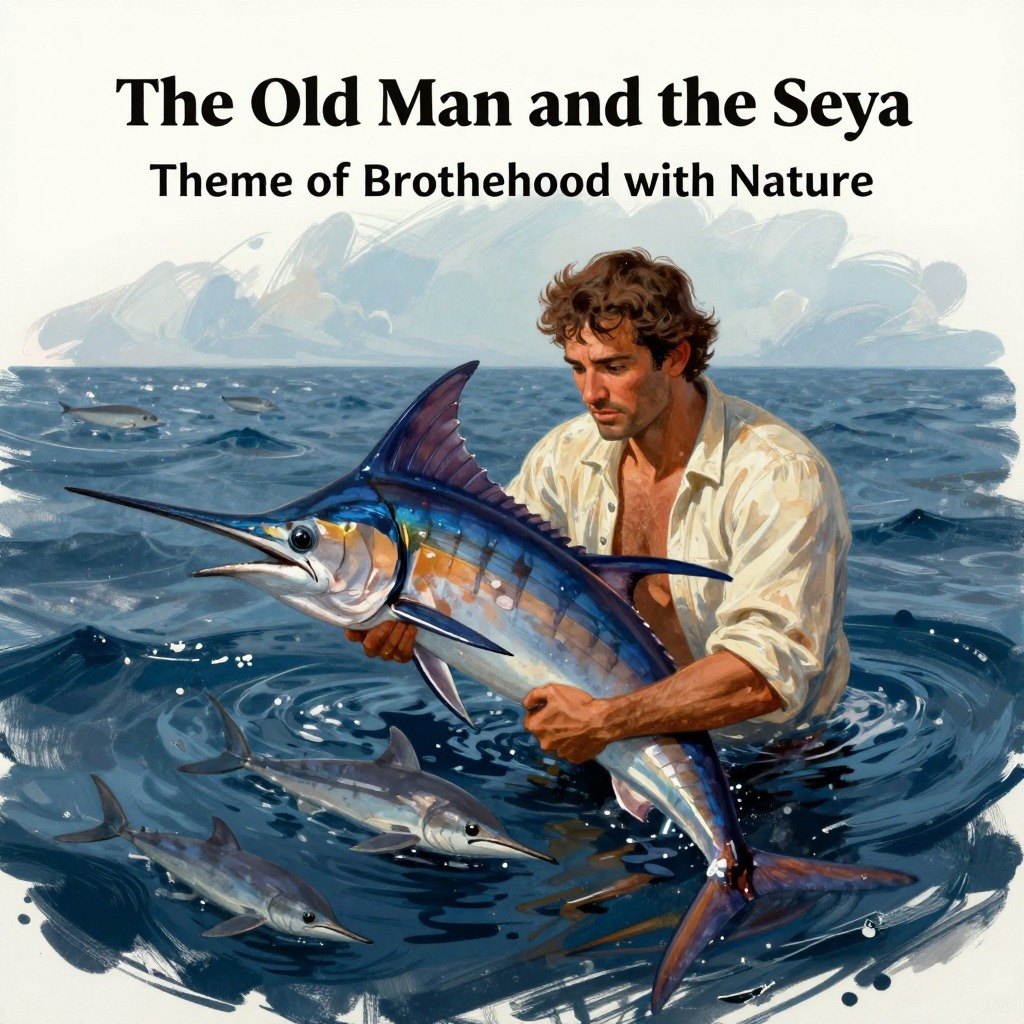
The porpoises are among the few creatures Santiago explicitly names as brothers during his ordeal at sea, embodying a principle of joyful, non-predatory kinship that stands in stark opposition to the sharks that later destroy his catch. In a narrative dominated by struggle, exhaustion, and loss, the porpoises offer moments of warmth, companionship, and moral clarity, revealing the old man's deepest values about life, love, and the bonds that unite all creatures of the ocean.
Identity and Symbolic Role
Santiago identifies the porpoises as "our brothers like the flying fish," placing them in a category of creatures he loves and respects without reservation. Unlike the sharks, which he regards as enemies, scavengers, or noble adversaries, the porpoises inspire no conflict, no fear, and no need for violence. They are simply good. The old man hears them during the night after hooking the great marlin, and he can distinguish between the blowing noise of the male and the sighing blow of the female, a detail that shows his intimate knowledge of their behavior and his attentive, affectionate observation. He reflects that porpoises "play and make jokes and love one another," attributing to them a capacity for joy, humor, and mutual affection that he deeply admires. This characterization makes the porpoises a living embodiment of the harmony and love that Santiago believes should exist among all beings, a vision of the sea as a community rather than a battlefield.
The Porpoises in Santiago's Dream
During his second night at sea, when Santiago finally allows himself to sleep, he does not dream of the lions that usually visit him. Instead, he dreams of a vast school of porpoises that stretches for eight or ten miles, in the time of their mating, leaping high into the air and returning into the same hole they had made in the water. This dream is remarkable for its scale and its peaceful, reproductive imagery: the porpoises are not hunting or being hunted; they are mating, leaping, and playing. The dream replaces the lions, Santiago's most cherished recurring vision, suggesting that the porpoises have become, in this moment of extreme physical and emotional strain, an even more potent symbol of life, continuity, and natural grace. The dream occurs after Santiago has already declared the porpoises his brothers, and it deepens that bond by placing them at the center of his unconscious mind, the place where his deepest longings and memories reside.
Contrast with the Sharks and the Marlin
The porpoises serve as a moral and emotional counterpoint to the sharks that attack Santiago's marlin. Where the sharks are described as cruel, able, strong, intelligent, and driven by hunger, the porpoises are playful, loving, and harmless. The Mako shark, the dentuso, is beautiful and noble but ultimately a killer; the galanos are hateful, bad-smelling scavengers. The porpoises, by contrast, inspire no such ambivalence. They are pure good. This contrast is central to Santiago's ethical framework: he loves the marlin as a brother even as he kills it, but he loves the porpoises without any need for violence. They represent a relationship with the sea that is not based on struggle, domination, or death. When Santiago says, "It is enough to live on the sea and kill our true brothers," he acknowledges the tragic necessity of killing the fish he loves, but the porpoises remain outside that necessity, untouched by his hands, a reminder of what the sea could be without the fisherman's bloody work.
The Porpoises and Santiago's Philosophy of the Sea
Santiago's attitude toward the porpoises is consistent with his broader view of the sea as a feminine, living entity that gives and withholds great favors. He thinks of the sea as la mar, a woman, and he loves her even when she is cruel. The porpoises, as her creatures, share in that femininity and that capacity for love. They are not adversaries in a contest; they are fellow inhabitants of a world that is both beautiful and dangerous. Santiago's ability to hear the difference between the male and female porpoises, and his appreciation of their play and love, shows that he sees them not as abstractions or symbols but as individual beings with their own lives and relationships. This attention to the particular, to the concrete reality of each creature, is the foundation of his ethics: he does not generalize about "the porpoises" as a category; he listens to them, dreams of them, and calls them brothers.
Narrative Significance and Thematic Resonance
The porpoises appear at key moments of transition and reflection in Santiago's journey. They are first heard during the night after he hooks the marlin, when he is alone, exhausted, and beginning to feel the full weight of his struggle. Their presence reminds him that he is not entirely alone, that the sea is full of life and love. Later, the dream of the porpoises comes at a moment of extreme physical depletion, when Santiago is about to face the most dangerous phase of his fight with the marlin. The dream gives him a vision of abundance, joy, and natural harmony that sustains him through the coming ordeal. Finally, the porpoises are part of the larger pattern of Santiago's relationship with the sea: they are his friends, his brothers, and his teachers, showing him that even in a world of struggle and death, there is room for play, love, and joy. They are, in the end, one of the reasons Santiago can say, "No man was ever alone on the sea."